Many local specialists don't charge for a mold inspection in Charleston; ask when they call. A good one includes crawl space entry, moisture content readings on joists and subfloor, humidity measurement, and photographs. Laboratory testing runs $300–$900 when warranted, and per EPA guidance, visible mold with a known water source generally doesn't need testing first.
Here's what gets measured, and how to vet a company in a state with no mold license.
The crawl space is not optional
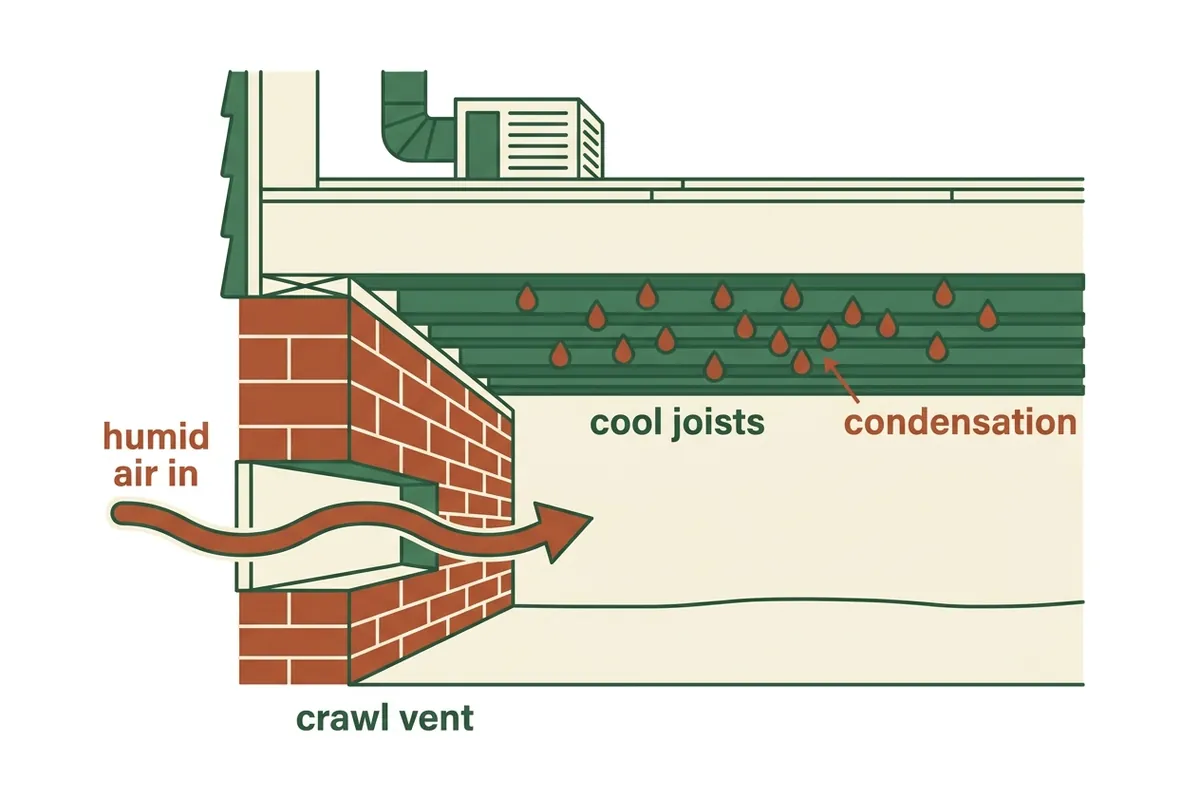
An inspection here that doesn't go under the house is guessing. Most Lowcountry mold problems either start in the crawl space or are being fed by it, and the evidence: condensation on joists, sagging wet insulation, a vapor barrier that has torn or was never installed, standing water, is only visible from down there.
What a good inspection records: moisture content on joists and subfloor at named locations, relative humidity in the crawl compared against inside the house, vapor barrier condition and coverage, insulation condition, duct condition and any condensation, standing water and where it comes from, and grading and downspout discharge outside that feeds it.
What gets measured upstairs
- Moisture readings at wall bases and any suspect surface, recorded by location
- Indoor temperature and relative humidity, compared against the crawl space numbers
- The air handler, return, and accessible ductwork
- Attic and bath fan terminations, where accessible
- Exterior walk: grading, downspouts, flashing, and evidence of tidal or storm intrusion
- Thermal imaging and a borescope where a cavity needs assessment without demolition
When testing is worth it, and when it isn't
The honest version: if you can see mold and know where the water came from, a lab result usually doesn't change what happens next. The remediation is identical regardless of the species named, and EPA guidance takes that position. A company insisting on testing every visible patch is billing for reassurance.
Four situations justify it. Odor with no locatable source after meters have been run. A health question where documentation is wanted. A real estate transaction, common here and frequently the reason someone calls. And post-remediation verification: the one case where testing is unambiguously worth its price, because it confirms the work succeeded.
No state license means you do the vetting
South Carolina does not issue a mold-specific contractor license. Some states (Florida among them) license mold assessors and remediators separately and restrict one firm from performing both roles on a project, precisely so the company sizing a job isn't the company paid by its size. South Carolina has no equivalent structure, which shifts that protection onto you.
Three questions carry most of the weight. Verify general contractor licensing through SC LLR. Ask what independent certification the technicians hold, from which body, and whether it's current. Ask to see the moisture readings that justify the recommended scope. Ask the specialist all three: a company that resents those questions has told you something useful.
Do you need testing, or do you need the source found?
Most people call having already seen or smelled something. Testing tells you what is in the air; it does not tell you where the water is coming from, and in this market the water is usually the whole answer.
| Method | What it answers | What it cannot tell you |
|---|---|---|
| Visual inspection | Where growth is and what it is growing on | Nothing about what is behind a finished surface |
| Moisture mapping | Where the material is wet right now | How long it has been wet, or what grew while it was |
| Surface sampling | Whether a specific patch is mould and roughly what kind | Whether the rest of the house is affected |
| Air sampling | Airborne spore levels against an outdoor baseline | The source: a high reading still leaves the hunt ahead of you |
South Carolina issues no mould-specific contractor licence, so verifying general contractor licensing and independent certification matters more here than in states that do. Be especially wary of free testing offered by whoever also wants the remediation contract.
Inspection questions, straight answers
Does the inspection include going under the house?
A good inspection includes going under the house, and it's the part that usually finds the answer. A mold inspection in this market that skips the crawl space has skipped the diagnosis. Most Lowcountry mold problems either originate down there or are being fed by it. It should include moisture content readings on joists and subfloor, not just a look around.
Do I actually need a lab test?
Often not. EPA guidance says visible mold with a known water source generally doesn't require testing, because the remediation is the same regardless of species. Testing earns its cost for odor with no locatable source, a health question needing documentation, a real estate transaction, or verifying a completed job.
What does an inspection cost?
Many local specialists don't charge for the visual inspection; ask when they call. It should include crawl space entry and moisture readings. Laboratory testing, when genuinely warranted, typically runs $300 to $900 depending on sample count and whether air sampling is included. Ask before anything is ordered whether a test will change the plan.
How do I vet a mold company in South Carolina?
Harder than in states with a mold license, because South Carolina doesn't issue one. Verify general contractor licensing through SC LLR, ask what independent certification the technicians hold and from which body, and ask to see the moisture readings behind the scope. Anyone who can't produce readings is quoting, not diagnosing.
What should a real inspection report include?
Moisture content readings at named locations including the crawl space, relative humidity both under and inside the house, photographs, an identified moisture source, and a scope tied to those findings. A report naming a price without naming where the water came from is a quote wearing a diagnosis costume.
Get a Charleston mold inspection
Tell us what you’re seeing or smelling: a musty smell coming up through the floor, cupping hardwood, condensation on ductwork, staining on a wall, and we'll pass your request to one independent local specialist, who can set up an inspection. A specialist who serves the Charleston area will call you back.